
New Concept: Silanol Control Type ODS Column
FEATURES
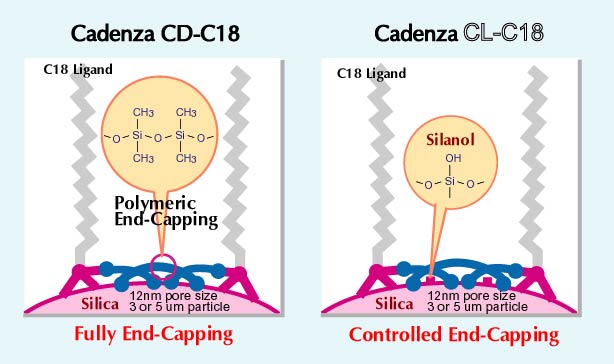
Silanol Control End-Capping
Change in Separation Selectivity compared to CD-C18
Column with the world's highest theoretical plate number of 50,000 plates (250x4.6mm)
High Separation Performance: Separation of Analogs and Isomers
Potential Alternative to Classical ODS Columns
Wide Range of Column Sizes: Inner diameter 0.075 - 28mm / Length 10-500mm
High Pressure Specifications Option
(HP: 500bar / 7,500psi / 50MPa, UP: 1,000bar / 15,000psi / 100MPa)
MAIN SPECIFICATIONS
| Particle size: | 3μm (Cadenza CL-C18), 5μm (Cadenza 5CL-C18) |
| Base materials: | Fully porous, high-purity silica gel |
| Pore size: | 12nm |
| Ligand: | Octadecyl group |
| End-capping: | Present (Silanol Control Type) |
| Target molecular weight: | Below 10kDa |
| pH range: | pH 2-7 |
| Maximum pressure: | 250bar / 3,500psi / 25MPa HP: 500bar / 7,500psi / 50MPa, UP: 1,000bar / 15,000psi / 100MPa |
| USP Code: | L1 |
Currently, the predominant type of ODS columns are "full end-capping" types designed to minimize residual silanols. As a result, when selecting any ODS column for separation studies, similar separation behaviors are often obtained.
In substance separation, not only the ODS ligands but also the polarity of the silica surface play a crucial role. However, excessive end-capping treatment leads to a loss of polarity on the stationary phase surface, resulting in similar elution behaviors that emphasize hydrophobic interactions.
While there exist ODS columns that do not undergo end-capping treatment after introducing ODS ligands, they often exhibit high residual silanol content with uneven distribution. This uneven distribution limits the uniform application of ion-exchange and electrostatic interactions, making peak tailing and reproducibility challenging.
Cadenza CL-C18 utilizes the same silica substrate as the fully end-capped Cadenza CD-C18, employing a similar ODS introduction process with primary end-capping to leave a small amount of residual silanols in the packing material. Therefore, interactions attributable to the substrate and ODS ligands are equivalent to those of CD-C18, with only slight differences designed in residual silanols affecting ionic and electrostatic interactions.
Consequently, compared to CD-C18, Cadenza CL-C18 offers potential improvements in separating compounds that CD-C18 may not achieve. Additionally, comparing both columns enables application in estimating substitution group structures in unknown substances.
Cadenza CL-C18 also boasts the feature of maintaining consistent retention of highly polar substances in 100% aqueous mobile phases, thanks to its high-density ODS with superior molecular recognition capabilities. By adjusting pH and ion strength appropriately in the mobile phase, it offers versatility from highly polar to low-polarity substances.
Decades ago, classical ODS columns with insufficient end-capping and residual silanols may still find methods for separation. In such cases, there exists potential for substitution with 5μm Cadenza 5CL-C18.
Technical Information
- ●Basic Interactions
- ●Electrostatic Interactions
- ●Differences with Unison UK-C18
- ●Separation Characteristics (π/dipole Interactions)
- ●Separation Characteristics (Polycyclic Aromatic Compounds)
- ●Separation Characteristics (Positional Isomers)
- ●Separation Characteristics (Neutral Compounds)
- ●Separation Characteristics (Acidic Compounds)
- ●Separation Characteristics (Basic Compounds)
- ●Batch-to-batch Reproducibility
- ●pH Durability
Applications NEW
Distinctive Applications
User Reports
-
●Testosterone Ultra-Sensitive LC-MS Analysis (SCIEX, USA)
By derivatizing testosterone with a novel quaternary aminooxy reagent and analyzing it using a Sciex QTRAP 5500 mass spectrometer and the Cadenza CL-C18 column, an LLOQ of below 1 pg/mL for standard samples and below 50 pg/mL for DBS samples was achieved.